
Plant Spacing Calculator
Enter the size of your bed or row and the spacing between plants. The calculator shows how many plants you need for a square grid, a triangular (staggered) layout and straight rows, including the gap to leave at the edges.
- Free to use
- No sign-up
- Runs in your browser
Calculate plants needed
Garden Bed Planting Planner
Plan every bed in the garden with automatic plant counts, plus printable grid sheets for square-foot and row layouts.
- Bed-by-bed planting workbook (XLSX, PDF)
- Printable bed grids & spacing chart (PDF, DOCX)
Formats: XLSX, PDF, DOCX. Instant download after payment (link valid 72 hours, up to 5 downloads). AI-assisted: the templates were drafted with AI help and reviewed and laid out before publishing.
$4.00 USD, one-time
- Instant download
- 7-day refund
- Secure checkout by Stripe
7-day money-back guarantee. Full refund within 7 days of purchase, even after you download.
Full refund within 7 days — see the refund policy and license.
Free printables
Single sheets you can print right now, no sign-up. The full pack adds every sheet in one download plus the editable files.
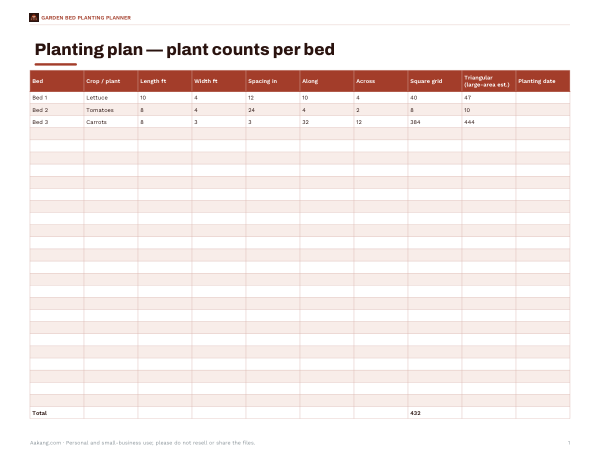 Printable Plant Spacing Calculator Sheet
 Printable Plant Spacing Chart
How plant spacing is calculated
Spacing is the distance from the centre of one plant to the centre of the next. In a square grid each plant sits at the corner of a square whose sides equal the spacing, so each plant uses spacing × spacing of ground. In a bed, the calculator counts how many plants fit along the length and across the width, leaving an edge gap — usually half the spacing — so the outer plants have room to spread without hanging over the path.
- Plants along the length = (length − 2 × edge gap) ÷ spacing, rounded down, + 1.
- Plants across the width = (width − 2 × edge gap) ÷ spacing, rounded down, + 1.
- Square grid total = plants along × plants across.
- For large areas without edges: plants = area ÷ spacing² (square) or area ÷ (spacing² × 0.866) (triangular).
Square or triangular planting?
In a triangular or offset layout, every second row is shifted by half the spacing, so each plant is the same distance from six neighbours. The rows are closer together — spacing × 0.866 apart — so the same bed holds about 15% more plants while every plant still gets its full spacing. Triangular spacing is common for ground covers, perennials, hedging and intensive vegetable beds. Square grids are easier to mark out and to weed with a hoe, and they suit square-foot gardening.
| Spacing | Plants per 100 sq ft, square | Plants per 100 sq ft, triangular |
|---|---|---|
| 6 in | 400 | 462 |
| 8 in | 225 | 260 |
| 12 in | 100 | 115 |
| 18 in | 44 | 51 |
| 24 in | 25 | 29 |
| 36 in | 11 | 13 |
Typical spacing for vegetables
Seed packets give the most reliable figure for a specific variety, but these ranges are typical for home gardens. Use the smaller figure in rich, raised beds and the larger one for vigorous varieties or poorer soil.
| Crop | In-row spacing | Between rows (row gardens) |
|---|---|---|
| Tomatoes, staked or caged | 18–24 in | 36–48 in |
| Peppers | 12–18 in | 24–30 in |
| Lettuce, heads | 10–12 in | 12–18 in |
| Leaf lettuce | 4–6 in | 12 in |
| Carrots | 2–3 in | 12–18 in |
| Onions, bulbs | 4–6 in | 12 in |
| Bush beans | 3–4 in | 18–24 in |
| Broccoli, cabbage | 18–24 in | 24–30 in |
| Cucumbers on a trellis | 12 in | — |
| Summer squash, zucchini | 24–36 in | 36–48 in |
| Sweet corn (in blocks) | 8–12 in | 30–36 in |
| Potatoes | 10–12 in | 24–36 in |
Square-foot gardening counts
Square-foot gardening divides a bed into 1-foot squares and plants a set number per square according to plant size: 1 for large plants such as tomatoes, peppers or broccoli; 4 for lettuce, chard or marigolds; 9 for bush beans, spinach or beets; and 16 for carrots, radishes and onions. Those numbers correspond to spacings of 12, 6, 4 and 3 inches. Enter one of those spacings with the edge gap set to half the spacing to reproduce the same counts for any bed.
Worked example
A raised bed is 10 feet by 4 feet and you want lettuce at 12-inch spacing, half a foot from each edge. Along the length there is 9 feet of plantable space, so 9 ÷ 1 + 1 = 10 plants; across the width there is 3 feet, so 4 plants. A square grid holds 40 plants. An offset layout with rows 10.4 inches apart fits 4 rows alternating 10 and 9 plants, 38 plants — fewer here because the bed is narrow. In a wide bed, the triangular pattern usually wins.
Ground covers, perennials and hedges
Nurseries usually recommend spacing that lets plants fill in within two or three seasons. Closer spacing covers faster but costs more; wider spacing saves money but leaves bare soil to mulch and weed for longer. For a hedge in a single row, use the row layout. For a double staggered hedge, set the width to the distance between the two rows and use the triangular figure. Adding a few spare plants — 5% is typical — lets you replace losses in the first season with plants from the same batch.
Why spacing matters
- Airflow: crowded plants stay wet longer, which encourages leaf diseases such as powdery mildew and blight.
- Light and roots: competition for light, water and nutrients reduces yield per plant even if the total number is higher.
- Access: you need room to harvest, prune and stake; leave paths or keep beds narrow enough to reach the middle, usually no wider than 4 feet.
- Mature size: always space for the plant's size at maturity, not its size in the pot.
Marking out the layout
For a square grid, stretch string lines along the bed at the row spacing and mark positions with a measuring stick. For triangular spacing, cut a stick to the spacing length, mark the first row, then offset the second row by half a stick and use the stick to form triangles with the plants of the row before. A cardboard template with holes at the right spacing is quick for small crops such as onion sets or carrots.
Frequently asked questions
How many plants per square foot at 6-inch spacing?
Four in a square grid, or about 4.6 in a triangular layout.
What is the triangular spacing factor?
Rows in an offset layout are spacing × 0.866 apart, so you need about 1.155 times as many plants as a square grid over the same large area.
Should I plant to the very edge of a raised bed?
Usually leave about half the spacing at each edge so the outer plants can spread; herbs and trailing plants can go closer.
Does closer spacing give a bigger harvest?
Up to a point. Intensive beds can yield more per square foot, but overcrowding reduces yield and invites disease.
How do I space plants in a circle?
Use “Known area”: area of a circle is 3.14 × radius². The count ignores the curved edge, so subtract a few plants.